How to play broomball | Beginner’s guide for women
Ready to take your shot and play broomball? I’ve got you covered with everything you’ll need to know about broomball before you go play, including the basics of broomball, where to play, equipment you’ll need, and overall ratings!
Welcome to the Take Your Shot Series where I (Kyla!) try new sports and activities to prove to myself (and you) that it’s never too late to learn and play sports. I’m reporting back with everything I learned to prepare you to take your shot!
The Edmonton Broomball Association hosts weekly broomball drop-in on Thursday nights at Glengarry Arena and they were kind enough to host my ball hockey team (Go Ducks!) to learn and play broomball! We started with learning the basics from a few players kind enough to teach us the game and then scrimmaged.
If you’re looking to play broomball in Alberta, check out associations in Edmonton, Calgary, and more here:


Do you want to me to come try your sport/activity or visit your organization/facility? Send me an email so we can make a game plan!
BEGINNER’S GUIDE TO BROOMBALL
Did you know there’s a sport similar to ice hockey that’s even played in a rink but doesn’t require skating? If you live in North America, you’ve likely heard of broomball, but the sport is also gaining popularity around the world. Instead of skates, hockey sticks, and pucks, players use special shoes to run on the ice, a ball, and a broomball stick (that was developed based on real brooms people used to play the sport with, hence the name!).
The game play is very similar to hockey, but the beauty of broomball is that it’s a far easier learning curve because you don’t need to skate to play — if you can run (or walk), you can play broomball.
My biggest fear going into broomball was running on the ice. As someone with bad knees, the thought of slipping and sliding everywhere terrified me, but I couldn’t believe how easy (and not scary) it was to move around on the ice. This is due in part to the grippy broomball shoes, but also because the ice resurfacer (Zamboni) leaves the ice more rough than when flooding it for hockey. While slipping wasn’t a big issue, learning how to quickly change direction and recovering from sliding without having skate blades to assist took some getting used to.
As a hockey goalie, I also took a shot at playing goalie and found that hockey goalie doesn’t translate as well to broomball goalie haha! My instincts were to butterfly constantly like in hockey, but that doesn’t help much in broomball. The net is much bigger (about a foot wider and taller) and you have less equipment on. The ticket was to combine hockey goalie and soccer goalie, which threw me off completely but was still fun to challenge myself!
My team and I had a total blast playing broomball and can’t wait to go back for more (it was great training!). Broomball is a cool sport because it allows you to play a similar sport to hockey or ringette without needing a ton of equipment or needing to know how to skate and it’s a welcoming sport with opportunities to play for fun or more competitively in tournaments like provincials and nationals.
PLAYERS NEEDED FOR BROOMBALL
12+
You need five players and one goalie per team. While you can make a game of it with the minimum number of players (or even do half ice play if you need to), broomball is quite intense with how much running you’re doing up and down the ice, so you’ll want some subs on the bench.
WHERE TO PLAY BROOMBALL
Broomball is normally played on an ice rink, but there are adaptations of the game that are played on a gymnasium surface (like floor hockey).
INDOOR HOCKEY RINK
Broomball is usually played on indoor hockey rinks where the ice surface is purposely made rougher by an ice resurfacer to provide traction when playing.
OUTDOOR RINK
If you live in a colder climate area, you can play or practice broomball on an outdoor rink. Depending on the weather, the ice surface will usually be good play on because it’s not maintained like an indoor rink, making it rougher and easier to play on.
COST TO PLAY BROOMBALL
The cost will depend on where and how much you’re playing.
ORGANIZED PLAY
Some organizations (like the Edmonton Broomball Association) may offer free drop-in play, but if you’re playing in a league or tournament, you’ll likely have to pay fees.
SELF-ORGANIZED PLAY
If you have your own equipment (or can borrow it), you can play for free on an outdoor rink in the winter or rent an indoor rink, which could cost you upwards of $200-$500 depending where you’re located.
EQUIPMENT NEEDED TO PLAY BROOMBALL
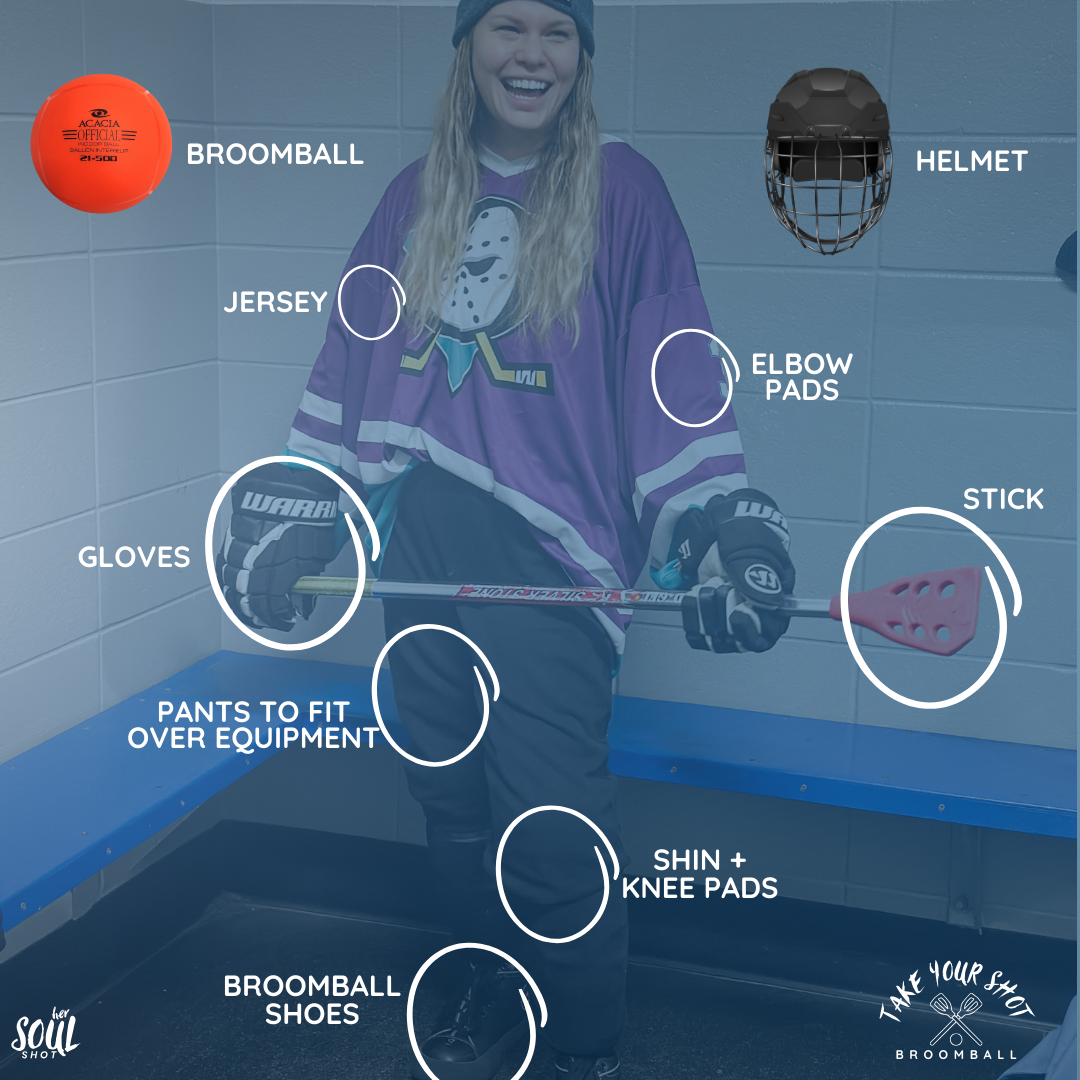
BROOMBALL BALL
Broomball uses a special ball that’s similar in size to a mini soccer ball and made from rubber. I was expecting the balls to be similar to a dodgeball, but they’re much harder. There are indoor (usually orange) and outdoor (usually blue) broomball balls.
BROOMBALL SHOES
While you can play broomball with regular court shoes, it is far safer and easier to play with special broomball shoes that have rubber grip on the bottom to provide grip on the ice.
We joked that our broomball shoes felt like we were wearing moon boots, but they were comfortable and definitely elevated the experience because we felt safer and could move easier on the ice!
BROOMBALL STICK
While the OG broomball sticks were literally corn brooms, they’ve since been elevated to sticks with a plastic or hard rubber “broom” on the end. The shaft of sticks come in wood, aluminum, or composite and the head of the stick can be straight or curved. Most broomball sticks are 46” but if you’re really tall or like to poke check on defence, you can go with a taller stick.
HELMET
You’ll need a hockey helmet to play broomball. Each organization will have differing rules, but most will require (or strongly suggest) a cage or full face shield as well.
GLOVES
You want padding on your hands/wrists to keep your hands safe from slashes. I used my ice hockey gloves because it’s what I had, but if you want a less bulky option, you can use broomball, lacrosse, or ball hockey hockey.
ELBOW PADS
Running on ice means you’re likely going to fall, so I highly suggest wearing elbow pads for protection. Most of us used hockey elbow pads, but you can wear any type of elbow pad that provides protection but doesn’t completely hinder your movement.
SHIN/KNEE PADS
Your legs will take a bit of a beating in broomball with the falling, sliding, slashing, etc. so it’s important to be protected. Most commonly, players will use a broomball or ball hockey shin/knee pad combo, but you can also wear ice hockey shin pads (what I wore and just used sock tape to keep them in place) or soccer shin pads with separate knee pads (like volleyball knee pads).
JERSEY
This also depends on where you’re playing, but most organized play requires a hockey jersey to go over your equipment (try to bring a light and a dark for scrimmages). If you’re playing self-organized play you can always wear a hoodie or other long sleeve option that fits over your gear.
PANTS
If you’re getting serious about broomball, you can get special padded broomball pants to go over your lower body gear, but for playing recreationally, you can just wear sweat pants that fit over your pads.
JILL
I didn’t wear a jill (pelvic protector) but that’s mostly just because I forgot to bring one. It never hurts to have additional protection (especially if you already have a jill you wear for other sports). If you want to grab one, I’d suggest getting the shorts with the built in jill option because you won’t have to worry about how to hold it up.
CLOTHING + SPORTS BRA
You’ll definitely want to wear a supportive sports bra as it’s a high impact workout with all of the running.
I debated wearing a sweater under my jersey but opted for a t-shirt instead and was glad I did as you definitely get warm pretty quick despite the chill of the rink. I wore spandex shorts under my sweat pants, but you can also wear leggings if that feels more comfortable under your leg pads. If you have a hockey baselayer, that would work to wear under everything!
GOALIE EQUIPMENT
Broomball goalies wear more equipment than players, but still less than a hockey goalie would. Broomball goalies wear everything a player does, with the addition of a blocker on the hand holding your broom and a soccer/lacrosse/broomball glove on your other hand, a chest protector (hockey, lacrosse, or special broomball one), and a goalie mask (or a player helmet with a cage). Goalies use the same stick as players and are not allowed to use hockey goalie leg pads.
PLAYING BROOMBALL
If you’ve played hockey before, you’re set to play broomball as there’s only a few key differences in game play and rules.
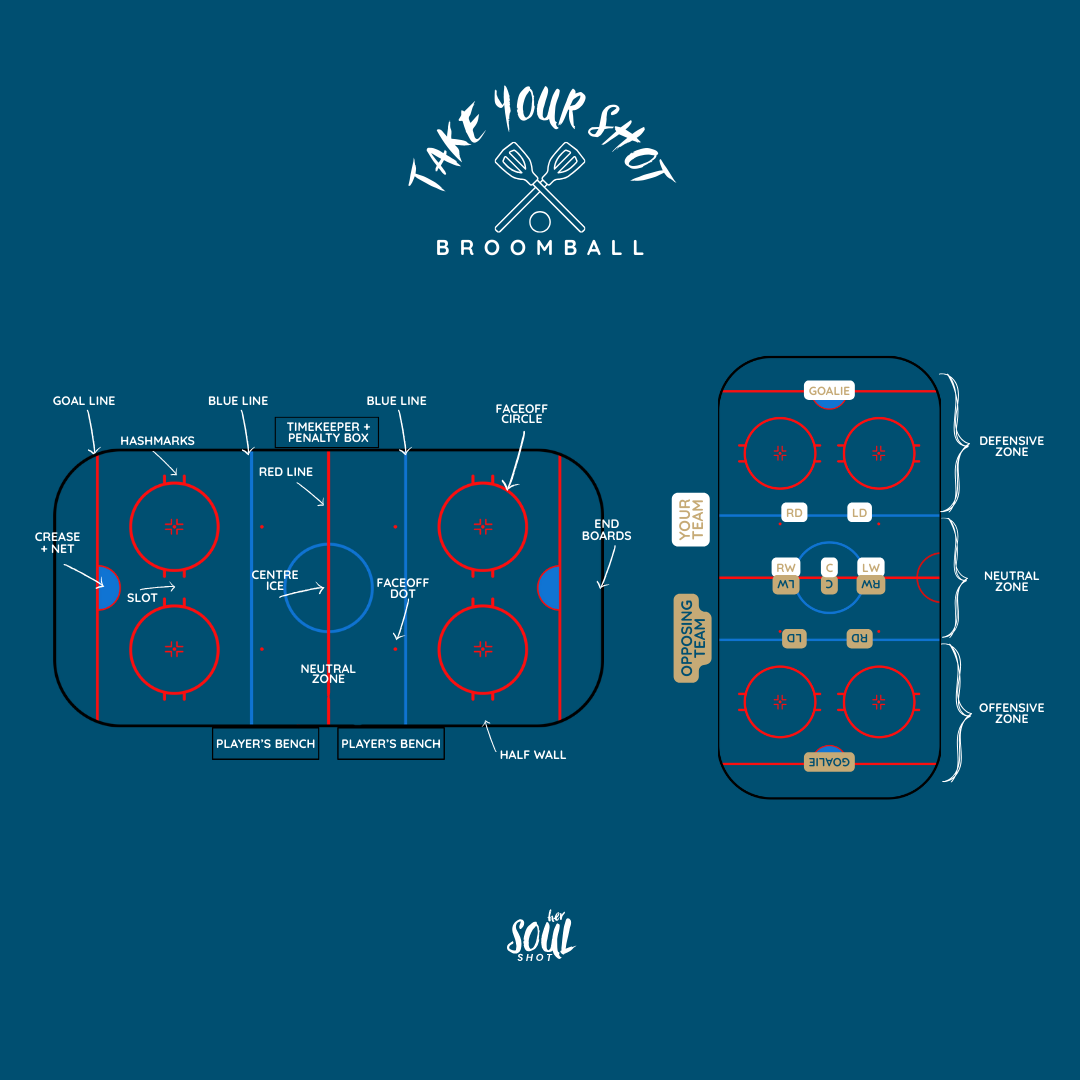
BROOMBALL GAME PLAY
Broomball is played with two teams playing against each other. Each team is allowed 5 players and 1 goalie on the ice at a time (3 forwards, 2 defence, and 1 goalie). There is a net (about a foot taller and wider than regular hockey nets) at each end of the ice that players will try to score on and defend — a goal is scored when the ball fully crosses the goal line (red line running along the mouth of the net behind the crease).
The team with the most goals at the end of the game wins. If teams are tied at the end of the game, the game will either go to overtime to determine a winner or end in a tie.
Games typically have two halves or three periods and teams switch ends after each half/period (your team will use the same players bench all game, but your goalie will switch ends, swapping the defensive and offensive zones).
League games and tournaments will have two referees on the ice to control the game while recreational games will typically have players call their own offsides, penalties, etc. to manage the game. The game begins with a faceoff at centre ice where the centre from each team lines up at the faceoff dot and the referee drops the ball. Faceoffs will be used to restart the game after goals and/or stoppages in play.
MOVING THE BALL
You’ll mostly be moving the ball with your broom, but you can also use your hands and feet to direct the ball. In “official” rules, players can’t catch, throw, or kick the ball directly to a teammate or in the net but many recreational leagues allow players to pass by kicking the ball, as long as it doesn’t go higher than the top of the boards. Like in hockey, you want to try to keep the ball to the outside of the ice and away from the middle of the ice where scoring chances are more dangerous.
MVP TIP: When you’re running on the ice, you want to make sure you’re staying aware of your speed so you’re not putting yourself (or others) in dangerous positions. It’s difficult to stop quickly on the ice or pivot to turn, so you need to take this into consideration when playing and make sure you’re not being reckless (penalties can be called for intentionally sliding into people and reckless play).
A big difference from hockey is the “failure to move the ball forward” rule in broomball to keep the play flowing. Players in the defensive zone must always be moving the ball towards the offensive zone (unless unable to do so because of opponents), so a player can’t purposely retreat to their defensive zone to run time off the clock or regroup (like in basketball when you can’t go “over and back” and cross half to the defensive zone once you’ve gained half court).
PASSING AND SHOOTING THE BALL
To pass and shoot the ball with your stick, you’ll want to hold it like a hockey stick with your dominant hand at the top of the shaft and your other hand towards the middle of the shaft. You can then pass or shoot the ball using the flat part of the broom with either a wrist shot where you flick the ball forward without winding up or use more of a slap shot style where you wind up and smack the ball with the broom part of the stick (almost a cross between a hockey slap shot and a golf swing). If you want additional power and speed in your shot, you can use the side of the broom head (the thin part) to connect with the ball, but this will make it much harder to be accurate in your shot placement.
BROOMBALL BASIC RULES
It’s important to note that different broomball leagues/organizations play by different rules, so always check before you play which rules are in effect.
For more in depth rules, check out these official rule books:
SCORING
Goals are scored when the ball fully crosses the goal line by a player shooting or directing the ball into the net with her broom. Goals can also be scored if the ball is deflected off of a player’s body or shoe into the net as long as it isn’t intentional. Goals will be disallowed if the ball is intentionally thrown or kicked in, the offensive team enters the crease before the ball (unless they’re pushed into the crease by a defensive player), or if the ball is scored by a high stick (above the player’s shoulders).
Players receive a point for scoring the goal and up to two players are awarded a point for an assist if they passed or directed the ball to the teammate who scored (without a member of the opposing team touching the ball in between).
LINE CHANGES
Players will take shifts on the ice (anywhere from 30-90 seconds) and sub on and off during stoppages of play or on the fly. When you’re not on the ice, you’ll be on the bench with your linemates. Defence will stand on the side of the bench closest to the goalie and forwards will stand on the side closest to the opposing team’s goalie, using the doors on their respective sides of the bench.
While you can change lines during the play, it’s important to only change when your team is in the offensive zone (or breaking into the offensive zone) so you’re not leaving open opposing players in your defensive zone while you change lines.
OFFSIDE
The offside in broomball is typically the red line. The ball must cross the centre red line before any offensive players for the play to remain onside. If the ball crosses back across the red line after a team has gained the offensive zone, all offensive players have to run back to cross the red line before the ball can enter the offensive zone again.
ICING
Icing is called when the ball is played (shot or kicked) by a defensive player from behind their defensive blue line and it crosses the offensive goal line without touching another player or the goaltender/net. The faceoff comes back to the defensive zone of the team that iced the ball.
PENALTIES
Penalized players in broomball will sit in the penalty box for the allotted time of the penalty (minor penalties are 2 minutes while major penalties are 5 minutes or more). The penalized player’s team will then play shorthanded (4 on 5) on the penalty kill while the opposing team will be on the powerplay for the time of the penalty. If the team on the powerplay scores, the penalized player can return to the ice before the penalty time is over. Teams cannot play with less than three players on the ice, so a 5 on 3 is the biggest advantage a team can have, even if there are multiple penalties.
If a goalie is penalized, they remain on the ice while one of their teammates on the ice when the penalty was committed must serve the penalty for them.
Like in hockey, there are minor, major, and misconduct penalties. Each league/organization will have different rules, but the standard penalties are: delay of game, tripping, slashing, hooking, holding, cross checking, high broom (called a penalty even if you only touch the ball with a high stick), interference, roughing and fighting, kneeing/elbowing, charging, boarding, hitting from behind, head shots, spearing, attempting to injure, and unsportsmanlike conduct.
If a penalty shot is awarded, the player taking the penalty shot can choose to either run the ball in from centre ice and try to score or set up 25 feet in front of the goal line and shoot directly on the goalie.
BROOMBALL POSITIONS
FORWARD
A forward line is made up of one centre and two wingers and their main focus is scoring goals.
The centre plays in the middle of the ice and is responsible for taking faceoffs and producing offence, while also helping the defence to prevent goals with a focus on covering the slot (the area of ice above the crease).
Wingers are either right wing or left wing and play on their respective sides of the ice (right wing is on the right side of the ice when facing the opponent’s net and vice versa). In the offensive zone, wingers retrieve balls from the corners, create plays, and screen the goalie. In the defensive zone, wingers cover the point (the other team’s defence) near the blue line to break up shots and passes and break the ball out of the defensive zone by carrying the ball, passing to a teammate, or banking the ball off the boards.
DEFENCE
A defence line is made up of two players, a right and a left defence, and their main focus is preventing the opposing team from scoring.
In the defensive zone, defence play low in the zone (near their goalie) and are responsible for covering open players, breaking up passes and shots, clearing rebounds, and sending the ball up to the forwards to break out. In the offensive zone, defence play at the point (near the opposing team’s blue line) and are responsible for keeping the ball in the zone and taking shots on net from the point.
GOALIE
There is only one goalie per team and their job is to keep the ball out of the net.
The goalie mostly plays in the crease (the blue paint in front of the net). In the crease, the goalie is allowed to catch, kick, or high stick the ball to make a save. When the goalie covers the ball, they can either hold it for a stoppage of play or play it to their teammates to keep the game going. If throwing the ball to a teammate, they must do so to the side or behind the net. They can only move the ball forward if they’re hitting it with their broom.
PLAYING BROOMBALL GOALIE
As an ice and ball hockey goalie, I was excited to try out playing broomball goalie. With bigger nets and less equipment, it was far more challenging than I thought it would be. Here’s the biggest things I discovered about playing broomball goalie:
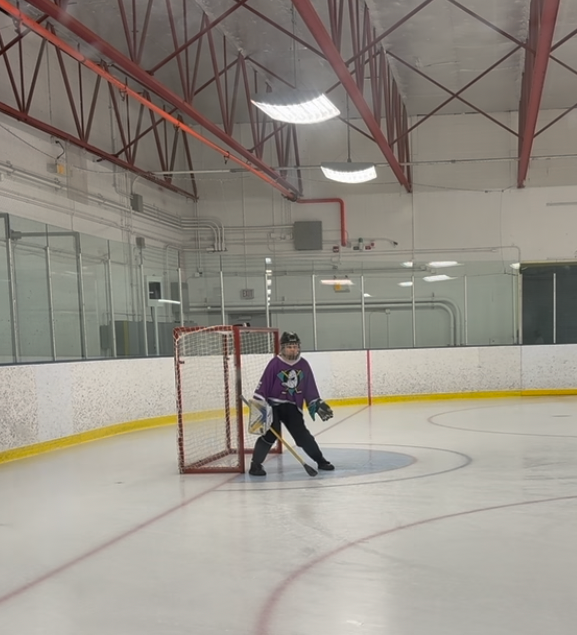
It’s much harder to move and cover the net in broomball. My instinct was to go into butterfly, but this leaves a ton of net open up top (the net is a foot higher) and also makes it hard to move as sliding is tricky and you can’t just cover the bottom of the net with your pads. It was hard for me to adjust mentally, but playing a mix of hockey and soccer goalie seems to be the way to go as you want to stay standing more than in hockey and use your feet for low shots.
The ball is way harder and shot much faster than I expected. I came pretty unprepared for goalie because I thought I’d mostly be playing out, so I was wearing a borrowed blocker, a hockey player glove, player shin pads, and elbow pads. Thankfully, they took it easy on me but watching how hard they could shoot on the empty net and the other goalie was making me rethink playing in net haha! You use your “glove”/free hand to stop and bat away the ball quite a bit and I was definitely wishing I had more padding on the palm/wrist of my glove because the sting was real! Next time, I’ll definitely wear a chest protector and a glove with more padding (maybe a soccer glove!). I also didn’t love playing in player shin pads as the insides of my knees got bruised from going into butterfly with them on, so I’ll likely wear volleyball knee pads under them next time.
I found covering/freezing the ball to be tricky. It’s so much bigger than a puck or ball hockey ball, so you can’t just absorb it into your body and freeze it. You have to either catch it with your hands (which is difficult when one is holding the broom) or bring it into your body on the ice. It was hard to get a handle on it and I kept feeling like it was slipping around.
A broomball goalie acts as a third defence, so teammates will pass the ball back to you to make a play. This absolutely tripped me up because I wasn’t expecting it and I was worried I’d be caught not paying attention and let the pass go in. I didn’t do much in the play because I was just trying to get the basics down, but broomball goalies are much more involved in the defensive zone play than hockey goalies (they just can’t cross the red line).
OVERALL THOUGHTS ON BROOMBALL
PHYSICAL DIFFICULTY
Rating: 7/10
Broomball will definitely test your cardio level with all the running and using muscles you didn’t even know you had but it’s a really great (and fun!) workout. If you’re playing recreationally, the intensity is less than at higher levels so you can pace yourself a bit more.
If you’ve played ice or ball hockey before, you’ll be set to play broomball! The biggest adjustment will obviously be running on the ice (especially figuring out how to change direction without being able to dig a skate blade in or grip the floor and turn) and learning how to use the broom stick to pass and shoot.
If you haven’t played hockey before, one of the coolest things about broomball is that it’s a way to play a sport very similar to hockey at the rink without needing to know how to skate or requiring a ton of expensive equipment. Getting used to the pace of play and learning positioning will take some time and practice, but otherwise you can play the game with minimal skills/experience and still make an impact and have fun.
MENTAL DIFFICULTY
Rating: 3/10
Going with my teammates definitely helped lessen my anxiety around trying a new sport (always go with friends if you’re scared!), but I did find myself having a lot of anxiety around getting injured (bad knees, remember?), which made it a bit harder for me to go “all out”.
Being a team sport, broomball definitely has less pressure than an individual sport and you get breaks in between shifts on the bench where you can chat with teammates, ask questions, etc. so you can really learn as you go and watch what others do while you’re on the bench.
ACCESS
Rating: 4/10
You do need an ice surface to play broomball, which can be an issue with limited ice time availability. If you live in a cold climate, you can play on an outdoor rink, which opens up your options. While you can use other sports equipment for some of your gear, you do need a few broomball-specific pieces of equipment to play that you likely don’t have just laying around from other sports (shoes, sticks, etc.).
Broomball isn’t an easy sport to just get together with your friends and play because of the ice and specific equipment needed, BUT if you can find an association or league near you, they’ll likely have designated ice times and equipment for you to borrow to come out and play. Broomball organizations are really welcoming and keen on getting more people involved in their sport, so many do a good job of making it accessible for everyone to play.
GET IN THE GAME WITH ALBERTA BROOMBALL ASSOCIATION
The Alberta Broomball Association has opportunities around Alberta to try broomball, play recreationally, and play competitively.
If you’re in Edmonton and want to play broomball, I highly recommend coming out to a drop-in game with the Edmonton Broomball Association! They play Thursday nights at 8:15pm at Glengarry arena throughout the fall/winter, are very welcoming to beginners, and have sticks, shoes, and other equipment you can borrow. Join their Facebook group to stay in the loop!
Ready to take your shot and play broomball? Check out our women’s sports directory to find a place to learn or play near you!


Check out adult women’s sports events and playing opportunities on our global event board!



The content above contains affiliate links.